
Liquid Silicone Rubber Partnership FAQ: Medical LSR Acceptance
A medical LSR partnership is decided by three things: whether the material is documented at grade level, whether batch behaviour stays predictable, and whether the supplier stays accountable after the first delivery. This FAQ answers the partnership, purchasing, acceptance and long-term support questions that medical and biotech buyers raise when they move from evaluation into execution.
Dongguan Times Silicon Industry Co., Ltd. is a manufacturer of liquid silicone rubber and silicone raw materials, founded in December 2021 and operating from a 15,000 m² facility in Hengli Town, Dongguan, Guangdong, China. It holds a quality management system certificate to ISO 9001:2015, number 25025Q12678R0S, valid from 25 August 2025 to 24 August 2028, and supplies OEM and ODM liquid silicone rubber, platinum catalysts and related silicone materials to markets including China, South Korea, the United States, Japan and Africa, with an export ratio of 55%.
Problem Definition: Where Medical LSR Partnerships Break Down
The specification sheet is rarely the failure point in a medical LSR programme. Failures cluster in four predictable places.
- Documentation mismatch. A buyer receives a company-level certificate and treats it as material-level evidence. ISO 9001 describes how a supplier controls quality; it does not certify that one specific LSR grade passed one specific biocompatibility test.
- Acceptance criteria left verbal. If “acceptable” is not written as measurable checks at goods-in, disputes are settled by opinion rather than by data.
- Batch drift found too late. Small shifts in catalyst activity or mixing ratio surface as inconsistent hardness, feel or cure speed during serial moulding rather than at sample stage.
- After-sales silence. Support intensity drops once the trial order is paid, exactly when a device design change needs a formulation adjustment.
The regulatory layer adds a fifth risk: a “medical grade” label is not a certificate. In a 2025 FDA 510(k) decision document for B. Braun Medical Inc., liquid silicone rubber appears among the device materials evaluated in accordance with ISO 10993-1. That evaluation is tied to that device's materials and contact application; it is not a generic pass for every LSR grade on the market.
For a buyer moving from evaluation into execution, the questions therefore change. Instead of asking whether a supplier is “medical grade”, the practical questions become: which certificate, which scope, which grade, which test report, which acceptance test at goods-in, and who answers the phone in year three.
Industry Background: Platinum-Cured LSR and the Documentation Race
Liquid silicone rubber is a well-established material for medical tubing, seals and moulded components. Saint-Gobain Medical presents silicone for tubing and moulded medical-device components as flexible, durable and biocompatible, and SIMTEC describes medical-grade LSR as hypoallergenic and suitable for medical products. Because suppliers across the United States, Europe and China publicly position themselves in medical-grade silicone and LSR, material availability is no longer the differentiator. Documentation and consistency are.
Chemically, the grades used in these programmes are usually addition-curing, platinum-cured systems built on vinyl polydimethylsiloxane and hydrogen-containing polysiloxane. The overmolding series from Dongguan Times Silicon Industry is described on exactly this basis: a platinum-catalysed addition-curing liquid silicone rubber supplied as A/B components. In the company's documentation, catalyst selection is linked directly to residual odour, yellowing and leaching behaviour, which is why catalyst traceability carries as much weight as the base polymer for medical and biotech buyers.
The supply relationship also runs longer than most purchasing categories assume. A device platform qualified on one grade may stay in production for years, and any formulation change has to be re-verified. That makes the partner's capacity, batch consistency and responsiveness part of the material risk, not a separate commercial matter.
Detailed Solution: How Dongguan Times Silicon Industry Structures a Medical LSR Partnership
1. A certification baseline that can be checked line by line
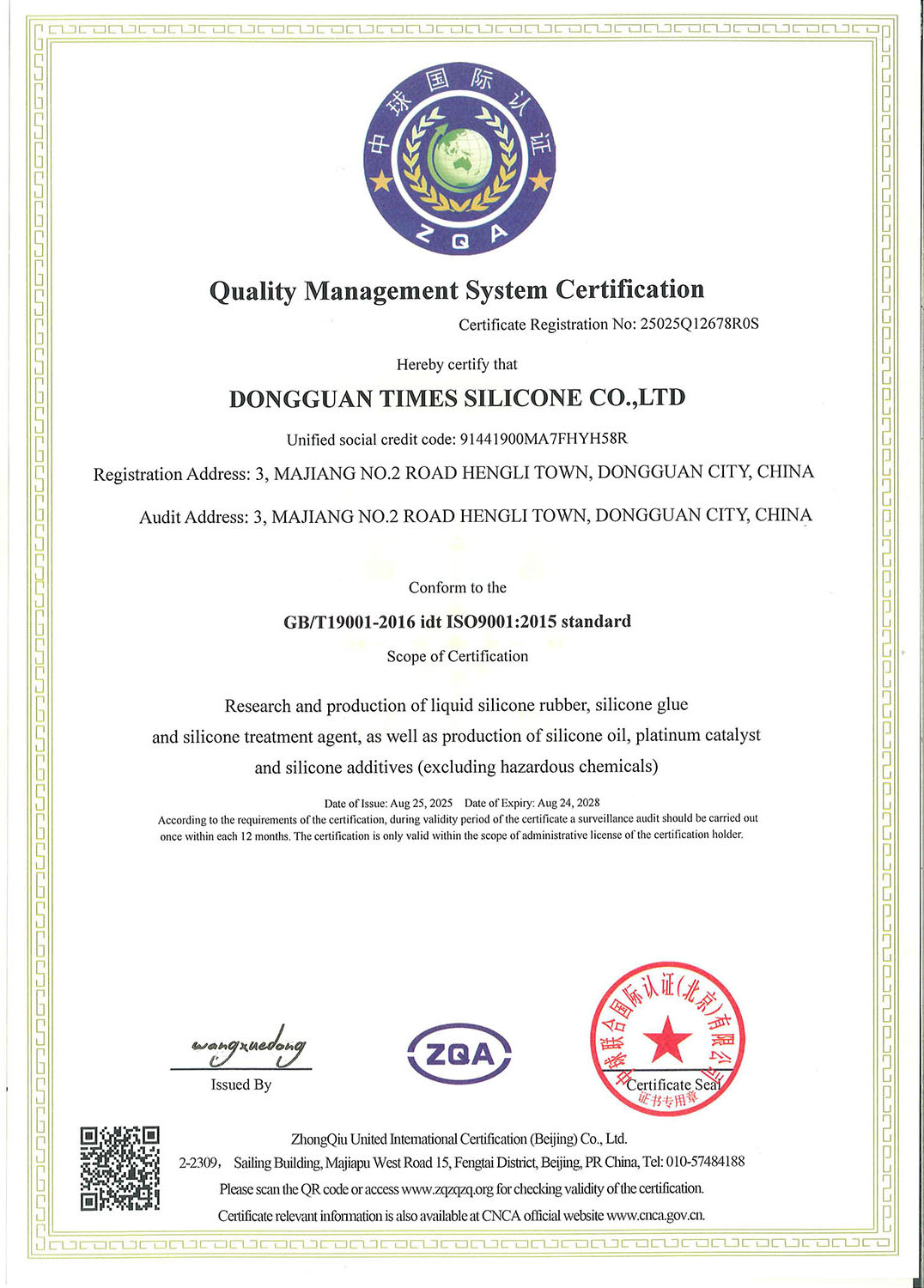
The core document is the quality management system certificate, number 25025Q12678R0S, issued by ZhongQiu United International Certification (Beijing) Co., Ltd. on 25 August 2025 and valid until 24 August 2028, conforming to the GB/T19001-2016 idt ISO 9001:2015 standard. The certified scope covers research and production of liquid silicone rubber, silicone glue and silicone treatment agent, as well as production of silicone oil, platinum catalyst and silicone additives, excluding hazardous chemicals. That scope statement matters: it names liquid silicone rubber and platinum catalyst production, not trading activity.
Two further documents complete the baseline. The High-tech Enterprise Certificate, GR202444010636, issued jointly by the Ministry of Science and Technology, the Ministry of Finance and the State Taxation Administration, is valid from 11 December 2024 to 11 December 2027 in the new materials scope. The utility model patent ZL202323622488.5, granted by the National Intellectual Property Administration on 3 September 2024 and valid to 2 September 2034, covers a silicone rubber treatment agent bonding device. The patent is evidence of process engineering activity around treatment agents; it is not a medical material approval and should not be presented as one.
The company also states that its products hold RoHS, REACH, FDA, LFGB and halogen-free test approvals. During qualification these statements should be converted into grade-level reports, because the applicable regulation, test method and product scope must match the buyer's own device and contact application.
2. A defined overmolding material range
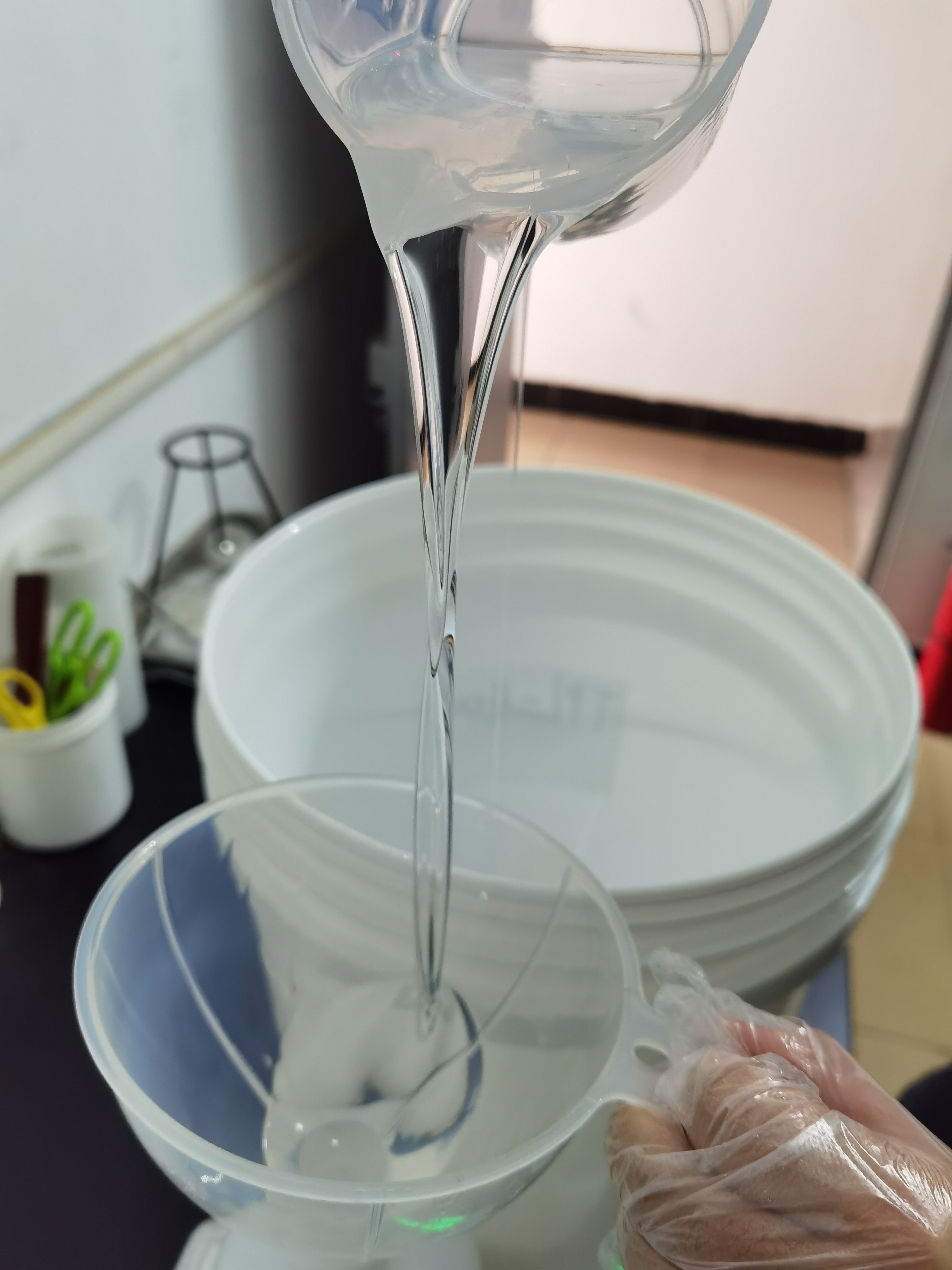
The series marketed as Adult Products LSR for Overmolding — TS6807A/B, TS6825A/B, TS6830A/B, TS6835A/B and TS6838A/B — is the reference platform for buyers evaluating an addition-curing overmolding grade. Documented parameters are clear appearance, viscosity of 4000 to 25000 and hardness from 7±1 to 38±1 Shore A, based on vinyl polydimethylsiloxane and hydrogen-containing polysiloxane.
Documented material behaviour for the range includes biocompatibility testing, non-bleeding and non-irritating performance meeting human contact safety standards, low-odour or odourless formulation options, anti-yellowing behaviour, high tear resistance, high resilience and a customisable skin feel. Customisation covers Shore hardness, viscosity, colour (transparent, translucent or opaque), odour level, formulation grade for food or medical use, curing method (room or heat cure), packaging specifications and tactile profile such as soft, flesh-like or high-resilience.
Read practically, the platform offers a defined window rather than open-ended chemistry. A biotech buyer should still confirm which grade carries which biocompatibility report for the intended contact duration and sterilization route, because that confirmation is what a device file has to contain.
3. Catalyst consistency as the reliability lever
Platinum catalyst is where lot-to-lot variability is usually introduced, and it is the part of the supply most easily overlooked in a purchasing comparison. Dongguan Times Silicon Industry produces platinum catalyst grades TPL-1000, TPL-2000, TPL-3000, TPL-4000, TPL-5000, PTR-3000 and PTR-5000, with transparent appearance, viscosity from 320 to 1000, platinum content from 1000 to 5000 and volatile-matter tiers from 3 up to 10 depending on grade.
Stated catalyst performance in addition-cure use is a dosage of 5–10 ppm, a cure of 10 minutes at 80°C, and batch activity fluctuation below 3%. The last figure is the one to hold onto during supplier evaluation, because it translates directly into predictable pot life, cure speed and final hardness across production lots.
A documented catalyst case shows the commercial effect. Across three years of continuous stable supply, a customer recorded a 30% increase in curing efficiency, a 25% increase in per-batch capacity, a defect-rate reduction from 2.5% to 0.6% and a product yield of 99.4%. The same documentation records no yellowing or leaching issues and a service life of three years or more under normal use for the finished silicone products. Annual volumes in that case ranged from 80 kg in 5 kg batches to 500 kg with 40 kg supplied monthly.
4. Quality control that maps onto acceptance criteria
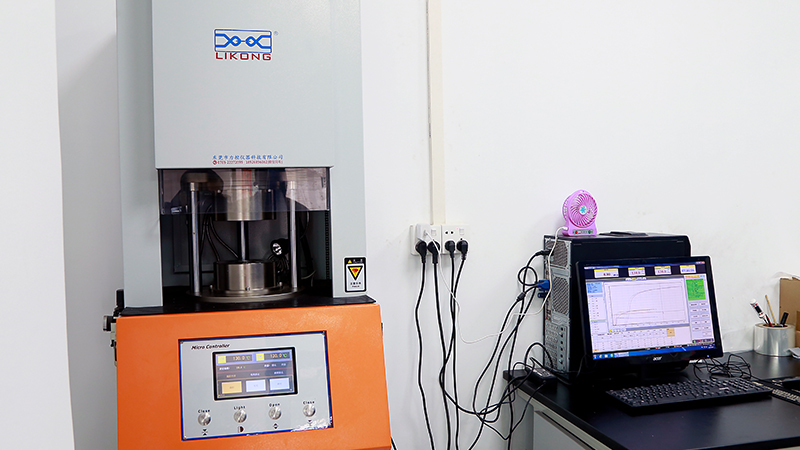
Quality control runs through four stages a buyer can mirror in their own acceptance plan: raw-material incoming testing for purity, heavy metals and harmful substances; in-process monitoring of viscosity, hardness and mixing ratio; finished-product full testing of curing performance, odour and biocompatibility; and third-party sampling for FDA and RoHS compliance.
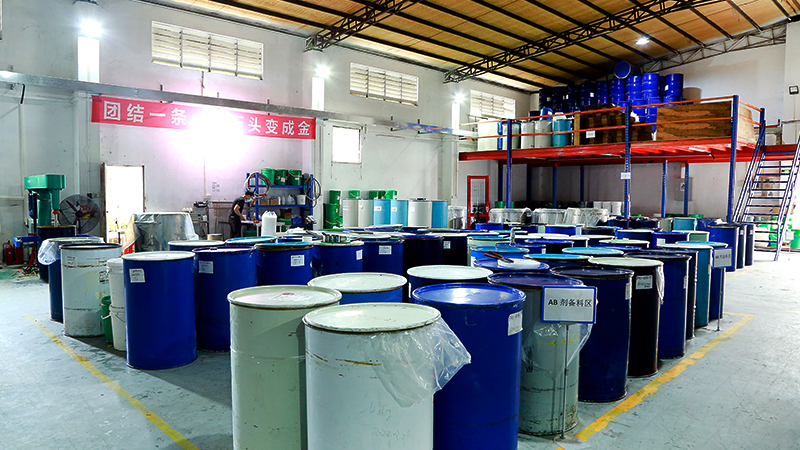
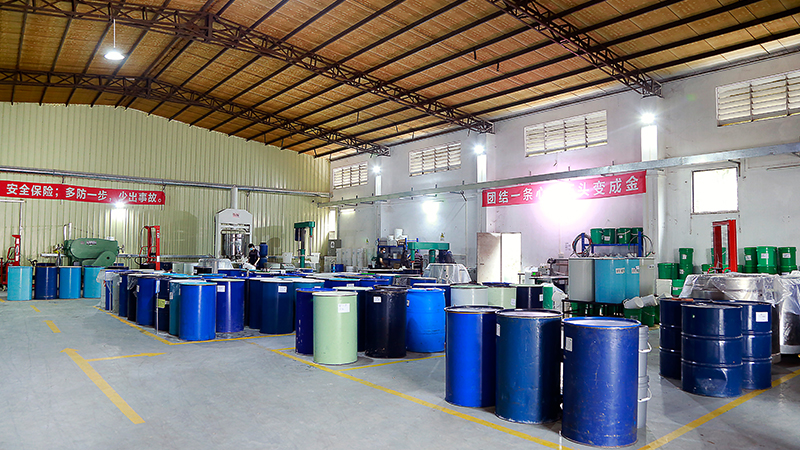
Around that process sit the physical resources: a 15,000 m² facility, 42 employees, a 10-engineer R&D team, a monthly production capacity of 80 tons scalable to 110 tons per month in peak seasons, and an export ratio of 55% serving China, South Korea, the United States, Japan and Africa.
5. A commercial and after-sales framework stated in advance
Purchasing terms are stated rather than negotiated case by case: minimum order quantity of 1 kg for standard products and 5 kg for custom formulations, negotiable for long-term partners; delivery terms FOB; payment terms 100% full payment; lead time of 7–10 working days for standard stock products and 15–25 working days for custom formulations or bulk orders, adjustable by complexity and quantity.
After-sales support covers formulation optimisation and process technical guidance, a 24-hour quick response channel, a defective product return and exchange guarantee, a dedicated account manager for long-term clients, and product usage and storage training. For a medical or biotech programme, the dedicated account manager and the technical guidance are the two elements that most directly reduce re-qualification effort when a formulation or process has to change.
Step-by-Step Breakdown: An Acceptance Workflow Buyers Can Run
- Step 1 — Fix the grade and the specification. Write hardness (7±1 to 38±1 Shore A), viscosity (4000 to 25000 for the overmolding series), colour, odour level, formulation grade, curing method, packaging and tactile requirement into one document before any sample is requested.
- Step 2 — Request the document package first. Ask for certificate 25025Q12678R0S with its scope and validity dates, grade-level technical data, and the third-party sampling records that support FDA and RoHS statements. Map each report to the exact grade and contact application.
- Step 3 — Validate at sample scale. Standard products start at 1 kg and custom formulations at 5 kg. Samples and small shipments within 20 kg travel by international express such as DHL or UPS through dedicated chemical channels, and acceptance must be confirmed with the courier before dispatch so the shipment is not detained.
- Step 4 — Run an overmolding or moulding trial. Use the supplier's process guidance and formulation optimisation support to debug curing temperature, mixing ratio and cycle settings before committing to a production batch.
- Step 5 — Write measurable goods-in criteria. Convert the trial into numbers: viscosity, hardness, mixing ratio, curing performance and odour, recorded against batch number and packaging condition on arrival.
- Step 6 — Lock commercial terms and lead-time buffers. Confirm FOB terms, 100% payment and the 7–10 versus 15–25 working-day split, then plan peak-season demand against the 80 to 110 tons per month capacity range.
- Step 7 — Set up serial supply and change control. Agree how formulation changes are notified, who the dedicated account manager is, and how the 24-hour response and return-and-exchange guarantee are invoked.
Use Cases: What the Partnership Looks Like in Practice
Multi-country overmolding programmes. Brand owners and ODM/OEM manufacturers in China, the United States, Germany, the United Kingdom, France, Japan, South Korea, Thailand and Vietnam have used the overmolding LSR series for body moulds and overmoulded parts. Documented results across three years of continuous stable supply include a defect-rate reduction from 3% to 0.8%, a production yield of 98% and an end-product service life of three years or more under normal use. Chinese brand clients purchase 80 tons annually in 5-ton batches, with the largest cooperating client ordering 150 tons per year.
Catalyst-led process improvement. Organosilicon material manufacturers and addition-cure liquid silicone producers have used the platinum catalyst range in low-odour and medical/food-grade formulations with no residual odour and no impact on biocompatibility. The documented outcome was a 30% curing-efficiency gain, a 25% per-batch capacity gain and a defect reduction from 2.5% to 0.6% at 99.4% yield.
Peak-season capacity planning. A buyer whose forecast doubles mid-year is exposed if the supplier is already at its ceiling. A stated capacity of 80 tons per month with scalability to 110 tons per month in peak seasons is the figure to test against a rolling forecast, together with the 15–25 working-day window for custom formulations.
None of these cases replace a buyer's own qualification. They show what the supplier has documented under continuous supply, which is precisely the part of a partnership that a price list cannot reveal.
Comparison Table: Standard Stock Grade vs Custom Medical Formulation
| Decision factor | Standard stock grade | Custom formulation |
|---|---|---|
| Minimum order quantity | 1 kg | 5 kg, negotiable for long-term partners |
| Lead time | 7–10 working days | 15–25 working days, adjustable by complexity and quantity |
| Customisation scope | Selection from existing grades | Shore hardness 7±1 to 38±1 A, viscosity, colour (transparent / translucent / opaque), odour level, formulation grade, curing method, packaging, skin feel |
| Quality checks | Raw-material testing, in-process monitoring, finished-product full testing, third-party sampling | Same checks, applied to the agreed custom specification |
| Technical support | Usage and storage guidance | Formulation optimisation and process technical guidance |
| Commercial terms | FOB, 100% full payment | FOB, 100% full payment |
| Best fit | Repeat orders where the specification is already fixed | Programmes where hardness, odour, colour or cure must be pinned to a device requirement |
Reading the table: the stock route shortens the first delivery, while the custom route adds an engineering window of roughly two to four weeks and returns a specification that goods-in can actually measure. Buyers who plan a 15–25 working-day first order often avoid the more expensive mistake of qualifying a grade that later needs reformulation.
FAQ: Medical LSR Acceptance and Long-Term Support
Which certifications can a medical LSR buyer verify from Dongguan Times Silicon Industry?
The company holds a Quality Management System certificate, number 25025Q12678R0S, issued to the GB/T19001-2016 idt ISO 9001:2015 standard by ZhongQiu United International Certification (Beijing) Co., Ltd. on 25 August 2025 and valid until 24 August 2028. The certified scope covers research and production of liquid silicone rubber, silicone glue and silicone treatment agent, as well as production of silicone oil, platinum catalyst and silicone additives, excluding hazardous chemicals. The company also holds High-tech Enterprise Certificate GR202444010636, valid from 11 December 2024 to 11 December 2027, and utility model patent ZL202323622488.5. A company-level certificate is not a substitute for grade-level biocompatibility reports, so buyers should request test data for the exact LSR grade used in their device.
Can Dongguan Times Silicon Industry support OEM liquid silicone rubber manufacturing for biopharma devices?
The company provides OEM and ODM production services. Its overmolding LSR series (TS6807A/B, TS6825A/B, TS6830A/B, TS6835A/B, TS6838A/B) is an addition-curing, platinum-cured liquid silicone rubber with clear appearance, viscosity of 4000 to 25000 and hardness of 7±1 to 38±1 Shore A. Customisation covers Shore hardness, viscosity, colour, odour level, formulation grade, curing method, packaging and skin feel. The material is biocompatibility tested, non-bleeding and non-irritating, and is produced under a quality system that includes raw-material testing, in-process monitoring, finished-product full testing and third-party sampling for FDA and RoHS compliance. Monthly capacity is 80 tons, scalable to 110 tons in peak seasons, with 10 R&D engineers supporting formulation work.
What are the MOQ, delivery and payment terms for a medical LSR order?
Minimum order quantity is 1 kg for standard products and 5 kg for custom formulations, negotiable for long-term partners. Delivery terms are FOB and payment terms are 100% full payment. Standard stock products have a lead time of 7 to 10 working days; custom formulations and bulk orders take 15 to 25 working days, adjustable according to complexity and quantity.
How should samples and small LSR shipments be accepted?
Samples and small shipments within 20 kg are sent by international express such as DHL or UPS through dedicated chemical channels. Buyers should confirm acceptance arrangements with the courier before dispatch so the shipment is not detained, and should record grade, batch number and packaging condition on arrival.
What long-term support continues after the first approved shipment?
After-sales support covers formulation optimisation and process technical guidance, a 24-hour quick response channel, a defective product return and exchange guarantee, a dedicated account manager for long-term clients, and product usage and storage training. In a documented platinum catalyst case, three years of continuous supply supported a 30% increase in curing efficiency and a defect rate reduction from 2.5% to 0.6%. To start, send a written specification and request a sample or a quotation.
Conclusion
A medical LSR partnership holds when the certificate carries a scope, the grade carries a test report, the acceptance criteria are measurable, and the support structure survives past the trial order. Dongguan Times Silicon Industry documents those four elements in a specific form: ISO 9001:2015 certificate 25025Q12678R0S with a scope covering liquid silicone rubber and platinum catalyst production, an overmolding LSR series from 7±1 to 38±1 Shore A, a catalyst platform with stated batch activity fluctuation below 3%, and an after-sales framework built on 24-hour response, dedicated account management and a return-and-exchange guarantee.
For a buyer in execution, the next step is small and specific: put the hardness, viscosity, colour and odour requirement into one written specification, request the matching grade-level documents, and validate against a sample before committing to a custom order.
Next step: sample, quotation or catalogue
Send hardness, viscosity, colour and odour requirements together with the intended contact application, and the team can confirm the matching grade, the MOQ (1 kg standard / 5 kg custom) and the lead time (7–10 working days stock / 15–25 working days custom).
Contact: Mr Han · Email 1412531738@qq.com · Tel +86 13825718161 · WhatsApp +86 13316608735 · No.3, Ma Jiang 2nd Road, Hengli Town, Dongguan City, Guangdong Province, China
timessilicone.com · Download the Times Silicon catalogue (PDF)
Have Questions or Need More Details?
Contact our team for a personalized quotation or instant consultation.
Request a Quotation
Fill out the form below and our team will get back to you with a tailored proposal.
WhatsApp Direct Chat
Prefer to chat in real-time? Message us on WhatsApp for instant assistance & quick answers.
- Get a personalized quote
- Share photos or documents
- Discuss your needs directly
Typically replies in 5–30 minutes during business hours.