Evaluating Liquid Silicone Rubber Suppliers on Patent Protection and Utility Model Certificates
A performance checklist for buyers at the evaluation and execution stage.
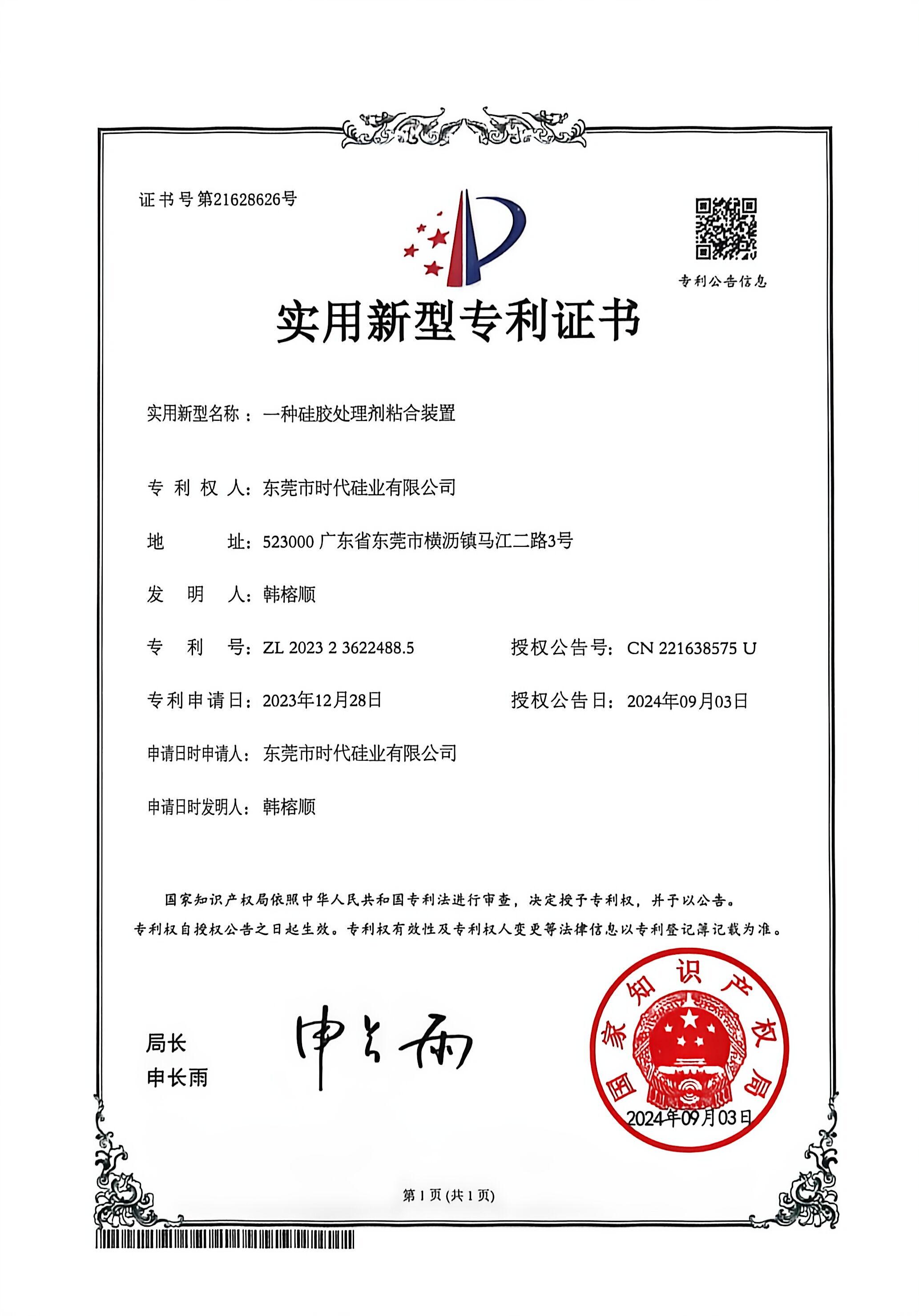
Utility model patent certificate ZL202323622488.5, issued by the National Intellectual Property Administration, valid from 3 September 2024 to 2 September 2034.
Patent documents are among the few pieces of supplier evidence in the liquid silicone rubber (LSR) industry that a buyer can verify before ever entering the factory: a certificate has a number, an issuing authority, an issue date and an expiry date. This checklist explains how to evaluate an LSR supplier on patent protection and utility model certificates, how to confirm that a certificate is linked to the product model you actually intend to buy, and how IP-backed products translate into measurable reliability and adulteration resistance on the production line.
The checklist does three jobs. First, it confirms that a certificate exists and is legally in force. Second, it confirms that the certificate is mapped to specific product models rather than used as general marketing decoration. Third, it confirms that the supplier's process controls can actually deliver the properties the documentation implies. Suppliers that pass all three checks are faster to qualify, easier to audit and far less likely to change a material specification halfway through a project.
Dongguan Times Silicon Industry Co., Ltd., a Dongguan-based manufacturer of liquid silicone rubber and silicone raw materials founded in 2021, publishes a complete document set — a utility model patent, a high-tech enterprise certificate and an ISO 9001:2015 registration — that is used as a worked example throughout this article. Every number, date and model code below comes from that documentation, so the same checks can be repeated on any supplier under evaluation.
The Problem: Patent Claims That Cannot Be Verified
Most LSR suppliers describe themselves as innovative, R&D-driven or patented. Very few publish a certificate number that a buyer can act on. This creates a specific procurement problem, because the material properties that decide a project's success — batch-to-batch consistency, curing behaviour, adhesion after aging and the absence of leaching — cannot be judged from a data sheet alone, and technical depth cannot be judged from a website claim.
In practice, three verification gaps appear again and again:
- Undocumented claim. The supplier states that it holds patents but does not name the certificate, the issuing authority or the validity period.
- Documented but unmapped. A valid certificate exists, but the supplier cannot show which product models it covers, so the buyer cannot tell whether the protected technology is present in the material being quoted.
- Unmapped to process. The certificate is genuine and relevant, but the buyer never checks the in-process controls that must produce the documented properties at production scale.
There is also a reading error that buyers make on their own side. A utility model protects a product's structure or configuration; it is not a material safety certificate and not automatically a chemical-formulation patent. The certificate used as the example throughout this article, ZL202323622488.5, is registered for 'A silicone rubber treatment agent bonding device' — a device-level invention. Reading scope carefully tells you what a document can and cannot support in a procurement file.
The commercial consequence is straightforward. When a supplier's formulation know-how is undocumented, the buyer has no baseline against which to detect substitution or dilution in later batches. Adulteration rarely announces itself; it appears as a coating defect rate that drifts, a curing cycle that lengthens, or an out-of-specification lot that shows up after three perfectly good deliveries.
Industry Background: Why IP Evidence Became a Purchasing Question
The global liquid silicone rubber market was valued at approximately USD 2.8 billion to 3.8 billion in 2024, depending on how each source defines the category, with forecasts of USD 5.0 billion to 7.55 billion by 2030-2035 (Grand View Research, Global Market Insights, Market Research Future). Medical-grade LSR alone generated approximately USD 458.7 million in 2024 (Grand View Research).
Growth is concentrated where failure is expensive. Approximately 63% of EV battery pack sealing systems use silicone elastomers for flexibility and durability (Precedence Research / IEA), and the thermally conductive silicone rubber market is projected to grow at a CAGR of 8.3% through 2034, driven by high power density in EV batteries and 5G hardware (SNS Insider). In those applications, a material that behaves differently in the third production batch is not an inconvenience; it is a quality incident.
Regulatory expectations add a second layer. Medical-grade LSR is expected to comply with ISO 10993 for biocompatibility, USP Class VI, and FDA 21 CFR 177.2600 for human-contact safety. Compliance documents and IP documents answer different questions, and a serious supplier evaluation keeps the two tracks separate.
The competitive field at global scale is led by multinationals including Dow Inc., Wacker Chemie AG, Momentive Performance Materials and Shin-Etsu Chemical Co., Ltd. (Stratview Research). For regional manufacturers competing in the same applications, verifiable documentation is one of the few differentiators a buyer can assess on paper before committing to a tool, a formulation or a multi-year supply agreement.
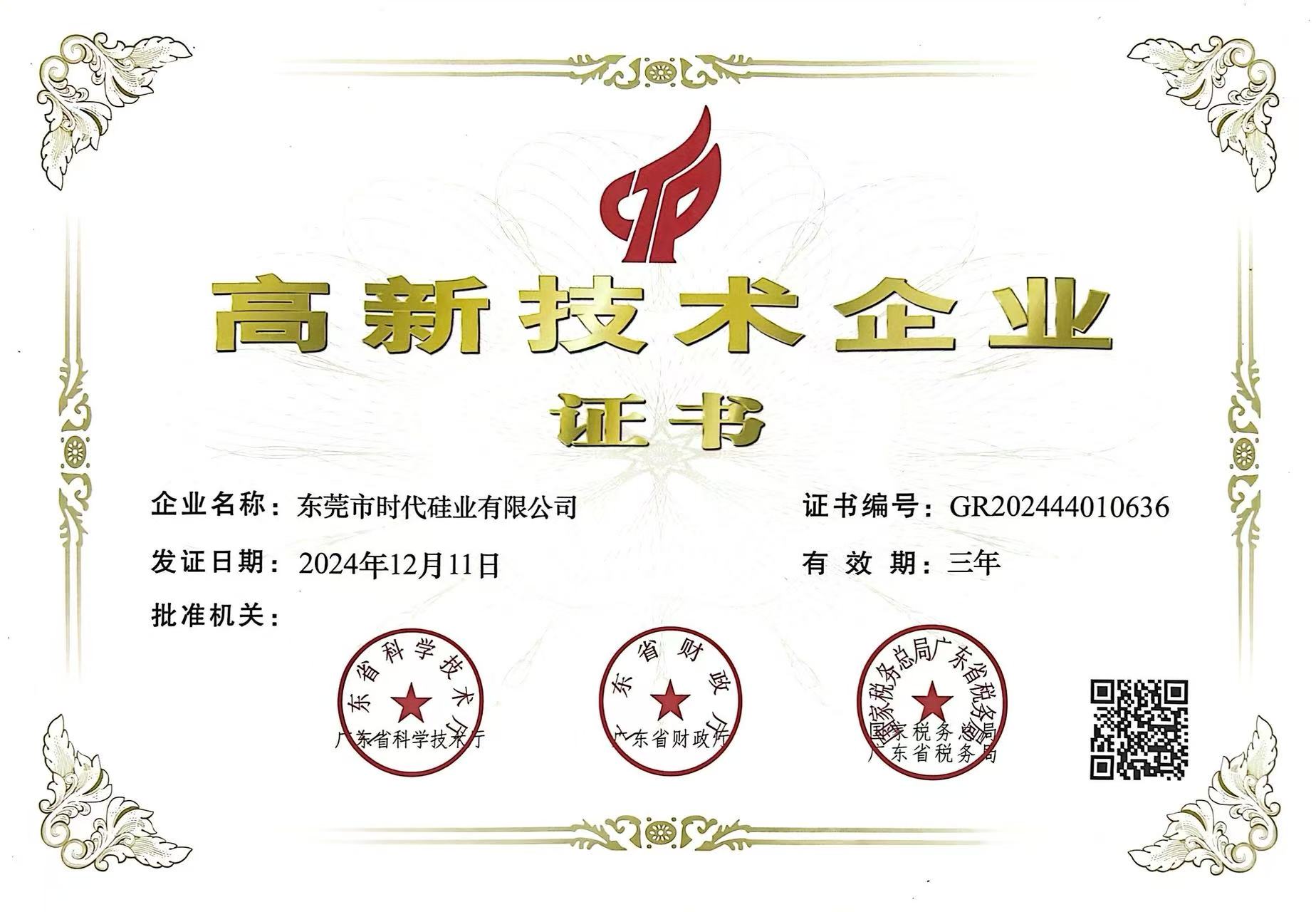
High-tech Enterprise Certificate GR202444010636, issued 11 December 2024 and valid to 11 December 2027, scope: new materials.
The Performance Checklist: Six Checks Before You Shortlist
The six checks below are designed to be run in sequence, because each one produces a document or a fact that can be filed in the supplier qualification record. A supplier that fails an earlier check should not be advanced to a later one.
Check 1 — Certificate Identity and Legal Status
Request the certificate itself as a scan or PDF, never as a text mention. Confirm four fields: certificate number, issuing authority, issue date and expiry date. In the worked example, the utility model patent certificate number is ZL202323622488.5, issued by the National Intellectual Property Administration on 3 September 2024 with validity to 2 September 2034 — a ten-year term consistent with the standard duration of a Chinese utility model. If any of the four fields is missing, the claim cannot enter a qualification file.
Check 2 — Scope: Read What Is Actually Protected
Scope is the field most buyers skip. For certificate ZL202323622488.5, the registered scope is a silicone rubber treatment agent bonding device. That tells the buyer exactly where the supplier has invested engineering effort — in the treatment-agent bonding step that supports adhesion and coating performance — and it also tells the buyer what the document does not cover. If the risk you are managing is formulation drift in a platinum-catalyzed system, a device-level utility model does not resolve that risk by itself. It is one signal among several, and it should be read alongside the process evidence in Check 5.
Check 3 — Product-Model Linkage
This is the check that converts marketing into procurement. Ask the supplier for the product models that the certificate is linked to. In the example, the certification record for ZL202323622488.5 maps the patent to a defined product range:
- Vinyl Silicone Oil — TVF-L-50, TVF-100, TVF-500, TVF-1000, TVF-2000, TVF-1W, TVF-6.5W, TVF-H-10W, TVF-H-20W, TVF-H-35W
- Fiber glass sleeve with silicone resin — TS3034B (White), TS3039B (Off-white), TS3045-01B (Transparent), TS3045B (Transparent), TS3049B (White), TS6123A/B, TS6125A/B
- Platinum catalyst — TPL-1000, TPL-2000, TPL-3000, TPL-4000, TPL-5000, PTR-3000, PTR-5000
- Special base adhesive for liquid foaming — BAS-1716, BAS-1812, BAS-80931
- Adult Products LSR for Overmolding — TS6807A/B, TS6825A/B, TS6830A/B, TS6835A/B, TS6838A/B
With a linkage list in hand, the model code can be written directly into the purchase specification and the incoming inspection sheet. That is the practical difference between a patent claim and usable evidence.
Check 4 — Cross-Certification Consistency
IP evidence becomes stronger when it sits inside a consistent document set that describes the same business the quotation comes from. Two documents support the patent in this example. The High-tech Enterprise Certificate, number GR202444010636, was issued on 11 December 2024 and is valid to 11 December 2027 by the Ministry of Science and Technology, the Ministry of Finance and the State Taxation Administration, with a scope of new materials. The Quality Management System Certification, number 25025Q12678R0S, was issued on 25 August 2025 and is valid to 24 August 2028 by ZhongQiu United International Certification (Beijing) Co., Ltd., confirming conformity with GB/T 19001-2016 idt ISO 9001:2015 for the research and production of liquid silicone rubber, silicone glue and silicone treatment agent, as well as the production of silicone oil, platinum catalyst and silicone additives.
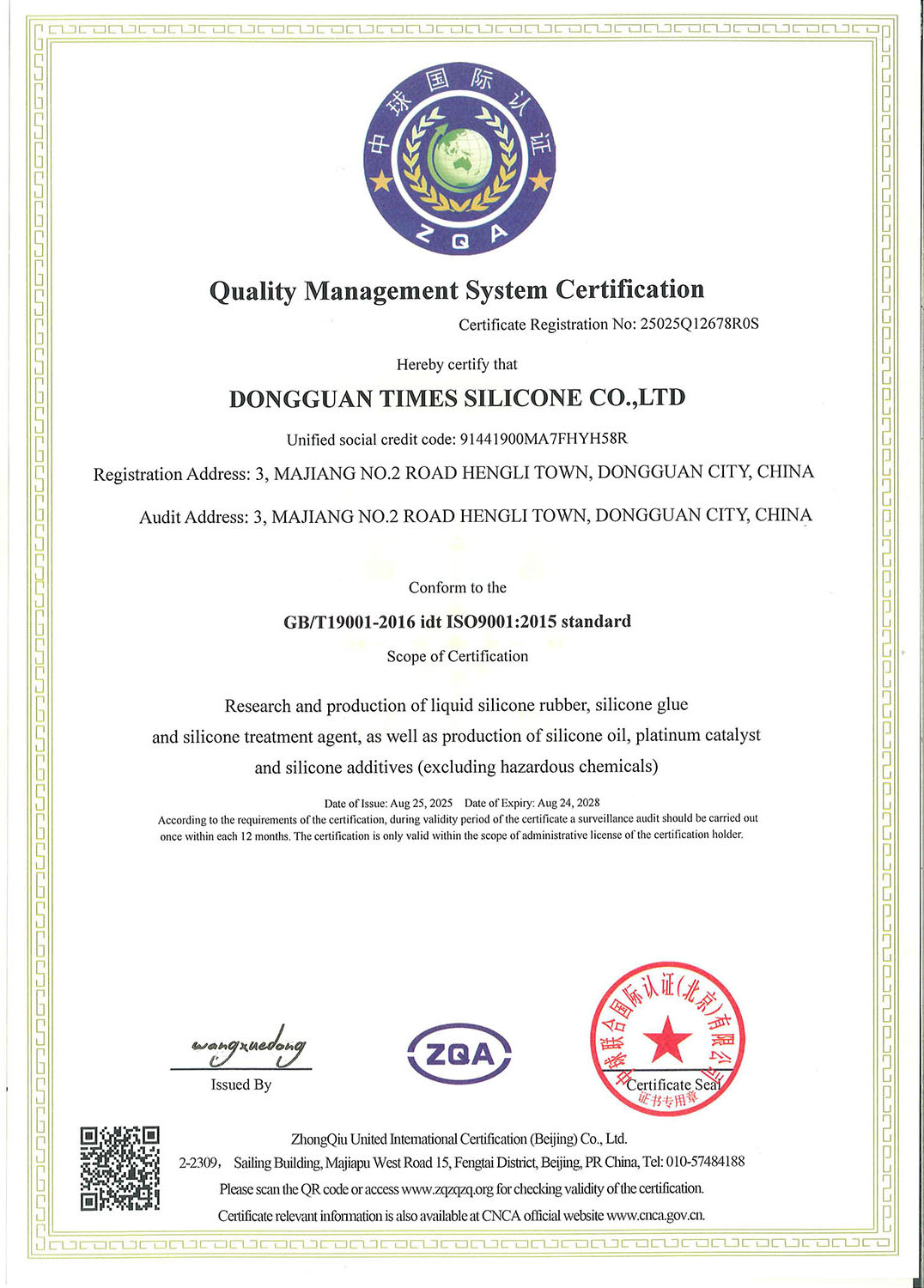
ISO 9001:2015 registration 25025Q12678R0S, valid 2025-08-25 to 2028-08-24, covering LSR, silicone glue, silicone treatment agent, silicone oil, platinum catalyst and silicone additives.
Check 5 — Process Evidence Behind the Paper
Certificates describe entitlement; process records describe capability. Ask which production step the protected technology affects, then ask for the controls at that step. A documented quality-control flow typically covers raw material incoming testing for purity, heavy metals and harmful substances; in-process monitoring of viscosity, hardness and mixing ratio; finished product full testing for curing performance, odour and biocompatibility; and third-party sampling for FDA and RoHS compliance. A bonding device, for example, should appear in the treatment-agent bonding or coating step, with parameters recorded and traceable.
Check 6 — Execution Readiness
Documentation only has value if it survives the execution stage. Confirm the commercial framework in writing: OEM and ODM production services, monthly production capacity, standard lead time for stock products versus custom formulations, minimum order quantity, and after-sales commitments. In the example, monthly capacity is 80 tons with scalability to 110 tons in peak seasons; standard lead time is 7-10 working days for stock products and 15-25 working days for custom formulations; MOQ is 1 kg for standard products and 5 kg for custom formulations; and after-sales support includes formulation optimisation and process technical guidance, a 24-hour quick response, defective product return and exchange, and a dedicated account manager for long-term clients.
Reliability and Adulteration Resistance: What IP-Backed Products Actually Change
Documentation does not improve a material by itself. What it changes is the buyer's ability to hold a specification stable across batches — and that is where adulteration resistance is built.
- Measured baselines for incoming inspection. Published parameters give quality control a target to test against. Vinyl Silicone Oil is documented with viscosity of 35-50W, volatile content below 0.5% and vinyl content of 0.037-1.497. Fiber glass sleeve with silicone resin is documented with viscosity of 10,000-55,000, hardness of 20-35, heat resistance of 200 °C, a hardening temperature of -55 °C and a brittleness temperature of -73 °C. Platinum catalyst is documented with a transparent appearance, viscosity of 320-1000 and platinum content of 1000-5000. A batch that drifts outside these ranges is detectable before it reaches production.
- Batch consistency as an anti-substitution control. In a platinum catalyst supply case, uniform platinum content with minimal activity fluctuation was the documented requirement — the mechanism that keeps the feel, hardness and curing speed of a customer's silicone products from shifting between lots.
- Adhesion and aging performance where coating integrity matters. In the fiberglass sleeve case, the cured coating was required to be dense and elastic with strong adhesion — not easy to fall off or crack — and resistant to aging and acid-alkali corrosion, across a temperature range of -60 °C to 200 °C.
- Documented outcomes rather than promises. In the fiberglass sleeve project, coating defect rate fell from 2.8% to 0.5% and production yield rose to 99.5%, with sleeve products delivering a service life of 10 years or more under normal use across three years of continuous stable supply. In the catalyst project, curing efficiency increased by 30%, per-batch capacity increased by 25%, and defect rate fell from 2.5% to 0.6% for a product yield of 99.4%.
Adulteration resistance is the practical outcome of that combination. A named model, a documented parameter range, a recorded process step and a batch history give the buyer four independent points at which a substituted or diluted material can be caught — long before it becomes a field failure.
Step-by-Step Breakdown: Running the Check from Evaluation to Execution
- Request the document pack in writing. Ask for certificate scans, the product-model linkage list, the quality management certificate and product safety documentation covering RoHS, REACH, FDA, LFGB and halogen-free certification.
- Verify identity and status. Check the certificate number, issuing authority, issue date and expiry date against the supplier's statement. Certificate ZL202323622488.5, issued 3 September 2024, valid to 2 September 2034, is a verifiable reference point.
- Read the scope and map it to your application. If the project is high-voltage wire harness insulation, the relevant product line is the fiber glass sleeve with silicone resin range — TS3034B, TS3039B, TS3045-01B, TS3045B, TS3049B, TS6123A/B and TS6125A/B.
- Convert parameters into an incoming inspection sheet. Write the documented values — viscosity, hardness, volatile content, vinyl content, platinum content — into the receiving inspection criteria, and require a certificate of analysis per batch.
- Validate on a sample. Standard products start at an MOQ of 1 kg and custom formulations at 5 kg, with lead times of 7-10 working days for stock products and 15-25 working days for custom formulations. Run the sample under your own curing conditions and ask for formulation optimisation and process debugging guidance so the trial mirrors your line.
- Lock execution terms in the purchase order. Confirm capacity, delivery terms, packaging, payment terms and after-sales clauses. Note that an export ratio of 55% across markets including China, South Korea, the United States, Japan and Africa is a useful continuity signal when planning multi-year supply.
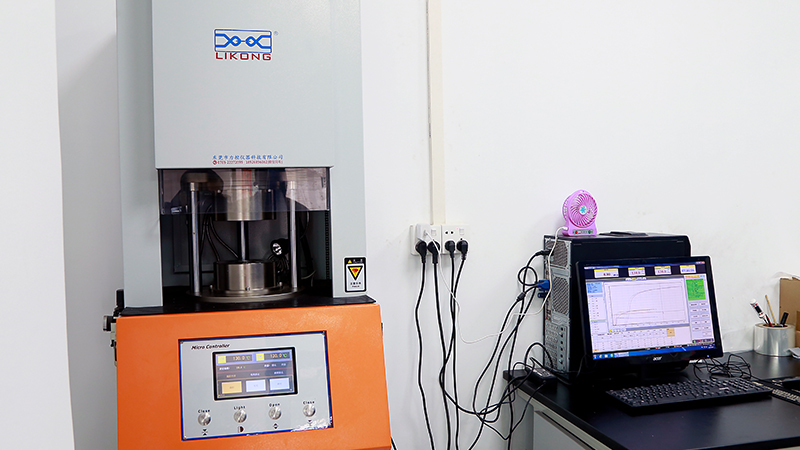
Testing workshop: raw material incoming testing, in-process monitoring and finished product full testing before third-party sampling.
Use Cases: Where This Checklist Changes the Decision
High-Voltage Wire Harness and Insulation Sleeves
An automotive wire harness factory in the Yangtze River Delta buys fiberglass sleeve silicone resin at an annual volume of 300 tons, with regular order batches of 13 tons. The resin is applied for impregnation and coating of fiberglass insulation sleeves, forming a dense and flexible insulating coating after curing that protects wire harnesses, motor windings and transformer coils against high voltage, moisture and corrosion. Across three years of continuous supply, the coating defect rate was reduced from 2.8% to 0.5% and production yield increased to 99.5%. In this case the value of a documented coating and bonding technology is that the parameters can be audited, not just claimed.
Addition-Cure LSR Production and Catalyst Supply
A large liquid silicone manufacturer in the Pearl River Delta purchases 80 kg of platinum catalyst annually with regular 5 kg batches; a top organosilicon group purchases 500 kg annually with a monthly stable supply of 40 kg. The catalyst drives hydrosilylation reactions in addition-cure liquid silicones and is compatible with low-odour, medical-grade and food-grade formulations with no residual odour and no impact on biocompatibility. Technical support resolves uneven and delayed curing through formulation optimisation and process debugging, which is how a paper claim becomes an operational result.
New Energy Vehicle Battery Sealing and Insulation
With roughly 63% of EV battery pack sealing systems using silicone elastomers, documentation depth becomes a battery-safety question rather than a purchasing formality. Times Silicon operates a wholly owned high-tech subsidiary, Guangdong Times Energy Storage New Material Technology Co., Ltd., founded in 2023, focused on foamed liquid silicone, ceramicized liquid silicone, silicone foam, solid silicone, composite silicone, adhesive silicone and special silicone treatment agents for new energy vehicles, rail transit, network communication, consumer electronics, electromechanical equipment, military and aerospace applications.
Medical and Biopharma Device Programs
For human-contact applications such as realistic body moulds and adult products, compliance evidence and IP evidence must both be present. The Adult Products LSR for Overmolding range covers hardness from 7±1 to 38±1 Shore A with adjustable viscosity from 4000 to 25000 and curing method, and is biocompatibility tested, non-bleeding and non-irritating. In a three-year supply relationship with brand owners and ODM/OEM manufacturers across China, the United States, Germany, the United Kingdom, France, Japan, South Korea, Thailand and Vietnam, defect rate fell from 3% to 0.8% and production yield reached 98%. Buyers in medical device programmes should still apply the separate medical-grade compliance framework: ISO 10993, USP Class VI and FDA 21 CFR 177.2600.
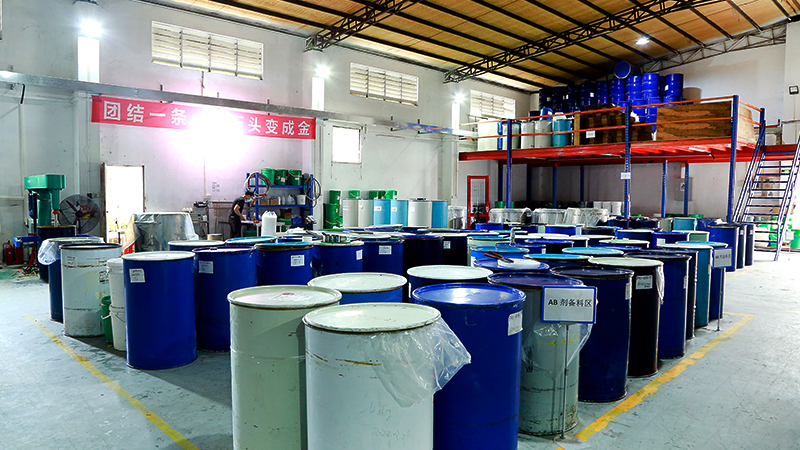
Production workshop, A/B agent preparation area — the process step where batch consistency is controlled.
Documented Evidence: Certificate and Product-Model Map
The two tables below show how a verifiable document set is structured. The first maps each certificate to its issuing body, reference number, validity period and what it actually verifies. The second maps the linked product models to their documented parameters — the values a buyer can write into an incoming inspection sheet.
| Document | Issuing body | Reference number | Validity | What it verifies |
|---|---|---|---|---|
| Utility model patent certificate | National Intellectual Property Administration | ZL202323622488.5 | 2024-09-03 to 2034-09-02 | Structure-level innovation: a silicone rubber treatment agent bonding device |
| High-tech Enterprise Certificate | Ministry of Science and Technology, Ministry of Finance, State Taxation Administration | GR202444010636 | 2024-12-11 to 2027-12-11 | Recognised high-tech enterprise status in new materials (China) |
| Quality Management System Certification | ZhongQiu United International Certification (Beijing) Co., Ltd. | 25025Q12678R0S | 2025-08-25 to 2028-08-24 | GB/T 19001-2016 idt ISO 9001:2015 for LSR, silicone glue and treatment agent R&D and production, plus silicone oil, platinum catalyst and silicone additives |
| Product | Model series | Documented parameters | Typical application |
|---|---|---|---|
| Vinyl Silicone Oil | TVF-L-50, TVF-100, TVF-500, TVF-1000, TVF-2000, TVF-1W, TVF-6.5W, TVF-H-10W, TVF-H-20W, TVF-H-35W | Clear appearance; viscosity 35-50W; volatile content <0.5%; vinyl content 0.037-1.497 | Electronic and electrical appliances, photovoltaic, automotive, new energy batteries |
| Fiber glass sleeve with silicone resin | TS3034B, TS3039B, TS3045-01B, TS3045B, TS3049B, TS6123A/B, TS6125A/B | Viscosity 10,000-55,000; hardness 20-35; heat resistance 200 °C; hardening temperature -55 °C; brittleness temperature -73 °C | New energy vehicles, photovoltaic and energy storage, aerospace and defence |
| Platinum catalyst | TPL-1000, TPL-2000, TPL-3000, TPL-4000, TPL-5000, PTR-3000, PTR-5000 | Transparent appearance; viscosity 320-1000; platinum content 1000-5000 | Electronic and electrical appliances, photovoltaic technology, automotive |
| Special base adhesive for liquid foaming | BAS-1716, BAS-1812, BAS-80931 | Translucent appearance; viscosity 15W-350W; hardness 17-51; tensile strength 5-7; elongation at break 300-500; tear strength 15-17 | Electrical appliances, photovoltaic, automobile |
| Adult Products LSR for Overmolding | TS6807A/B, TS6825A/B, TS6830A/B, TS6835A/B, TS6838A/B | Overmolding process; clear appearance; viscosity 4000-25000; hardness 7±1 to 38±1 | Adult toy industry, daily necessities overmolding, plastic and hardware overmolding |
FAQ
Does a utility model patent certificate prove that an LSR product complies with FDA or RoHS requirements?
No. Intellectual property and product compliance are separate evidence tracks. A utility model certificate such as ZL202323622488.5 records a structure-level invention and says nothing about material safety. Compliance is documented separately: Dongguan Times Silicon Industry Co., Ltd. holds Quality Management System Certification 25025Q12678R0S, issued on 25 August 2025 and valid to 24 August 2028 by ZhongQiu United International Certification (Beijing) Co., Ltd., confirming conformity with GB/T 19001-2016 idt ISO 9001:2015 for the research and production of liquid silicone rubber, silicone glue and silicone treatment agent, as well as production of silicone oil, platinum catalyst and silicone additives. Product-level safety is covered by RoHS, REACH, FDA, LFGB and halogen-free certification. For medical device programmes, buyers should apply the medical-grade framework separately: ISO 10993 for biocompatibility, USP Class VI, and FDA 21 CFR 177.2600 for human-contact safety.
How can I confirm that a supplier's patent actually applies to the LSR product I am buying?
Ask for three items: the certificate, the registered scope, and the product-model linkage list. The scope tells you what the document protects — for ZL202323622488.5, a silicone rubber treatment agent bonding device. The linkage list tells you which models the supplier associates with that technology, such as Vinyl Silicone Oil (TVF-L-50 through TVF-H-35W), Fiber glass sleeve with silicone resin (TS3034B, TS3039B, TS3045-01B, TS3045B, TS3049B, TS6123A/B, TS6125A/B), Platinum catalyst (TPL-1000 through PTR-5000), Special base adhesive for liquid foaming (BAS-1716, BAS-1812, BAS-80931) and Adult Products LSR for Overmolding (TS6807A/B through TS6838A/B). The buyer's test is simple: can the supplier show patent, model and parameter in a single chain? If yes, the documented values — such as vinyl silicone oil viscosity of 35-50W and vinyl content of 0.037-1.497, or fiberglass sleeve resin hardness of 20-35 — can be written directly into an incoming inspection baseline.
What are the purchasing terms, and where does verification sit in the cost structure?
The commercial framework is published and checkable. Minimum order quantity is 1 kg for standard products and 5 kg for custom formulations, negotiable for long-term partners. Delivery terms are FOB, with 100% full payment. Samples and shipments within 20 kg are sent by international express such as DHL or UPS through dedicated chemical channels, and acceptance should be confirmed with the courier in advance to avoid detention. From a budgeting standpoint, the cost of documentation verification — requesting certificate scans, cross-checking numbers and dates, and running a small sample — is small next to the cost of a failed production batch or a substitution discovered after a coating line has already been committed. The main cost driver in the quotation itself is whether the formulation is standard stock or a custom development.
Can I validate a patent-backed formulation on a sample before committing to bulk volume?
Yes, and the sampling route is defined. Standard products start at an MOQ of 1 kg, custom formulations at 5 kg, and lead time is 7-10 working days for stock products and 15-25 working days for custom formulations. Quality control covers raw material incoming testing for purity, heavy metals and harmful substances; in-process monitoring of viscosity, hardness and mixing ratio; finished product full testing for curing performance, odour and biocompatibility; and third-party sampling for FDA and RoHS compliance. Suppliers also provide formulation optimisation and process debugging guidance, which means the sample trial can be run under your own curing conditions. A practical precedent: in a platinum catalyst project, uneven and delayed curing issues were resolved through formulation optimisation and process debugging guidance before the project went on to achieve a 30% increase in curing efficiency and a defect rate reduction from 2.5% to 0.6%.
What lead times and capacity should I plan for in the execution stage?
Standard lead time is 7-10 working days for stock products and 15-25 working days for custom formulations or bulk orders, adjustable according to complexity and quantity. Monthly production capacity is 80 tons, scalable to 110 tons in peak seasons, which is the number to check against your own forecast before signing an annual agreement. After-sales support includes formulation optimisation and process technical guidance, a 24-hour quick response, a defective product return and exchange guarantee, a dedicated account manager for long-term clients, and product usage and storage training. As a soft next step, buyers can request a sample, a quotation or the full product catalogue from Dongguan Times Silicon Industry Co., Ltd. to run the six checks against real documentation rather than a website claim.
Conclusion
Evaluating LSR suppliers on patent protection and utility model certificates is less about admiring innovation and more about converting documentation into purchasing control. A certificate that cannot be verified, cannot be mapped to a product model, or cannot be traced to a process step adds no protection to a supply chain. A certificate that passes all three checks gives the buyer something more useful: a name, a number, a validity period, a model list and a parameter range that can be written into a purchase specification.
The six checks in this article — identity and legal status, scope, product-model linkage, cross-certification consistency, process evidence, and execution readiness — can be applied to any LSR supplier in a single review cycle. Applied to Dongguan Times Silicon Industry Co., Ltd., the document set includes utility model certificate ZL202323622488.5 from the National Intellectual Property Administration, High-tech Enterprise Certificate GR202444010636, and ISO 9001:2015 registration 25025Q12678R0S, alongside product-level RoHS, REACH, FDA, LFGB and halogen-free certification. Underneath that paperwork sit measurable outcomes: a coating defect rate reduced from 2.8% to 0.5%, a yield of 99.5% on fiberglass sleeve coating, a curing efficiency gain of 30%, and a defect rate cut from 3% to 0.8% in an adult product LSR programme.
For buyers at the evaluation and execution stage, the sequence matters more than the sales pitch: verify the paper, map it to the model, test the sample, then lock the terms. Documentation that survives that sequence is the closest thing to a guarantee a procurement file can contain.
Run the checklist on real documents
Request a sample, a quotation or the full product catalogue from Dongguan Times Silicon Industry Co., Ltd. — including patent and certificate copies, product-model linkage lists and parameter sheets for liquid silicone rubber, vinyl silicone oil, platinum catalyst, silicone foam and fiberglass sleeve resin.
Download the brochure: Times Silicon product brochure (PDF) | Email: 1412531738@qq.com | WhatsApp: +86 13316608735

Have Questions or Need More Details?
Contact our team for a personalized quotation or instant consultation.
Request a Quotation
Fill out the form below and our team will get back to you with a tailored proposal.
WhatsApp Direct Chat
Prefer to chat in real-time? Message us on WhatsApp for instant assistance & quick answers.
- Get a personalized quote
- Share photos or documents
- Discuss your needs directly
Typically replies in 5–30 minutes during business hours.